85-90% of the users use desktop/laptop because mobile application is not user friendly. However, more than 60% of users prefer mobile as most of the policies are issued on the go.
Case study: travel insurance workflows
Enterprise digital transformation for a leading general insurance provider in India
A focused redesign of the Travel insurance agent portal within a broader general-insurance transformation program.
RoleUX research, interaction design
Duration12 months
ScopeResponsive enterprise portal
Impact1-minute policy issuance

01 · Challenge
Challenge
The company needed to modernize its Travel insurance agent portal so agents could complete policy issuance faster, with clearer guidance and fewer workflow interruptions.
02 · Research process
4D double-diamond design approach

Discover
Define
Design
Decipher
UX
Heuristic evaluationCompetitor analysisUser interviews
Thematic analysisPersonaUser needs
Task flowsRapid prototypingWireframing
User testing
UI
Visual language identification
Theming and branding
Screen design
Cognitive walkthrough
Heuristic evaluation and competitor analysis
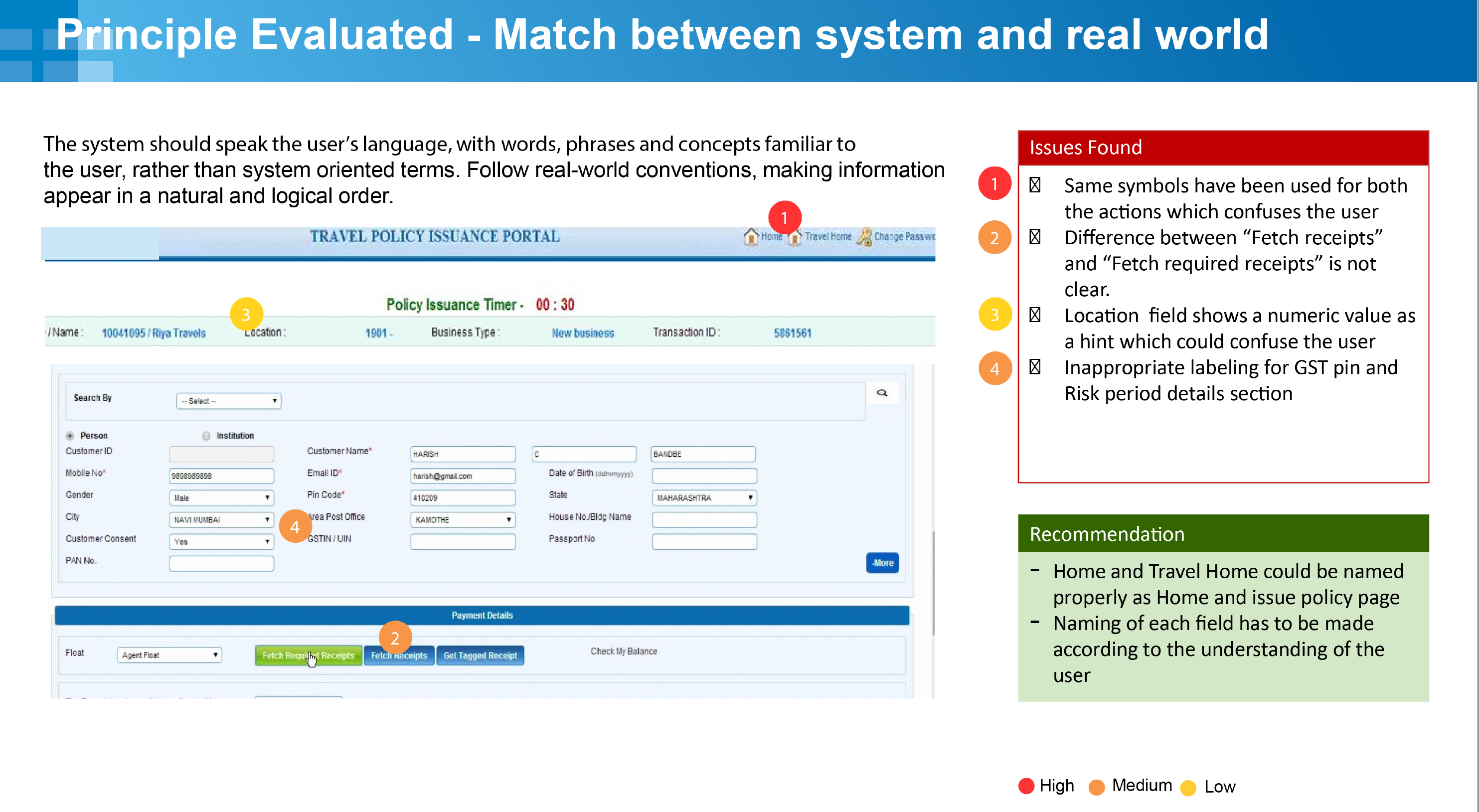
Heuristic evaluation was performed on all the pages of the portal based on Nielsen and Norman's heuristic principles. Prepared a report with all the issues found with appropriate recommendations.
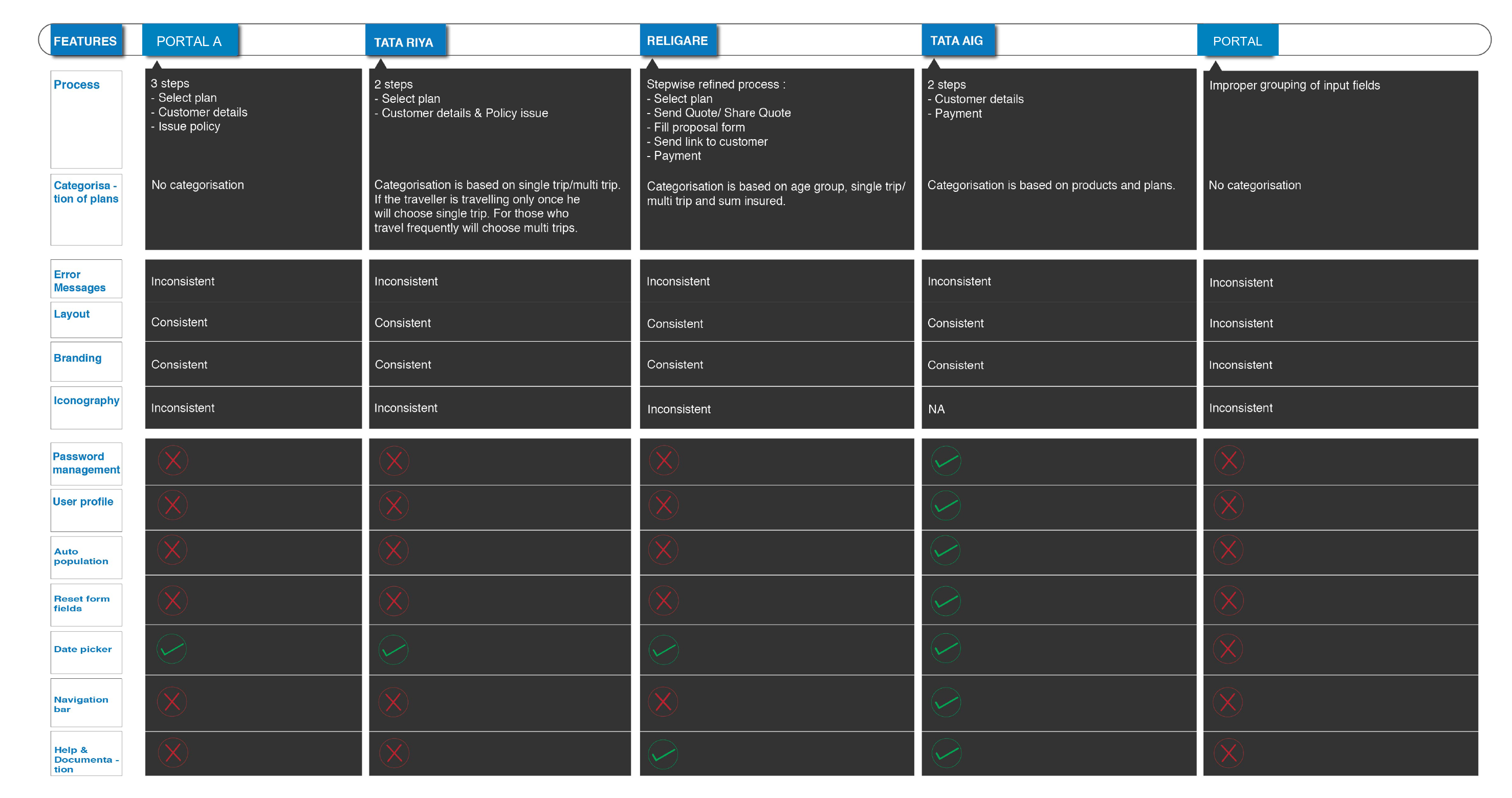
Feature based competitor analysis of 3 competitors Religare, TATA AIG, HDFC Ergo were performed. TATA AIG was made as benchmark product as the agents were able to issue a policy in less than 45 seconds by filling minimum number of mandatory fields.
Heuristic evaluation
Scroll horizontally to read the full image.
Competitor analysis
Scroll horizontally to read the full image.
TATA AIG was made as benchmark product as the agents were able to issue a policy in less than 45 seconds by filling minimum number of mandatory fields.
User interviews
User interviews were conducted with 8 agents, 2 back office employees. Prepared a set of open ended questionnaire designed in a way to get reliable feedbacks from the users. Visited the users (agents) and interviewed them to understand their work practices, pain-points, expectations.

User personas
Two types of user personas, primary user - Agent and secondary user Back office, were created based on different users participated in the user interviews. Collected their demographic details analyzed their responsibilities along with goals and the problems they face in achieving their objective while using the existing application.
Primary persona · Rohit, IMD / Agent

Scroll horizontally to read the full image.
Secondary persona · Shilpa, Operations Manager

Scroll horizontally to read the full image.
Thematic coding and data synthesis
- The interview outcomes were categorized into 4 categories namely observations, Design ideas, User statements and Insights.
- All the data collected were initially bucketed under 4 basic themes Findings, Expectations, Issues and Goals. On further analysis, various themes were derived.
- The user needs were framed from different themes derived and prioritized by MoSCoW rule.

Themes and research findings
Choice of device
Awareness of existing plans
Strategy used by agents to pitch a quote
Steps involved in issuing a policy
Policies issued per day or month
Back-office support for IMDs
Online verification
Plan categorisation
Payment modes
Modification rights after policy issuance
Business impact of existing policies
Technical issues and challenges
Out of 80+ available plans more than 70% of users did not know more than 7 existing plans that they use often.
It takes minimum 4 to 5 minutes to enter all the details (50 to 60 fields) to generate quote and issue a policy but in TATA AIG, only mandatory fields (10 to 15 fields) can be filled and a quote can be generated. A policy can be issued in less than 45 seconds.
No option to verify/validate customer details online, no option to share generated quote to customer online, so the customer should be near the agent while generating quote.
If the customer is more than 70 years of age or if the customer has pre existing disease, underwriter consent is mandatory for policy to be issued. But this process is not online, the agent has to visit back office to complete the process till then the policy doesn't get issued.
03 · Problem statement
Problem statement
"To develop an intuitive responsive web portal where the user is able to issue a policy by filling minimum number of mandatory fields where the application shows all the possible policies available for the specified premium from which the user can select multiple policies and share the quote generated with customer online, save the generated quote as draft and make the process of getting underwriter consent online."
04 · Solution
Task flows
Initially, the task flows were created and SMEs provided signoffs where the number of mandatory fields to be filled for generating a quote were reduced from 54 to 37. The number could not be reduced further due to the business policies the company followed.

54 → 37mandatory fields required to generate a quote
Paper prototypes and interactive wireframes
Paper prototypes were created to freeze unique set of screens after which clickable prototypes were created using Axure RP for different scenarios. Usability testing was conducted with users on core scenarios and feedback was taken based on which the designs were modified.
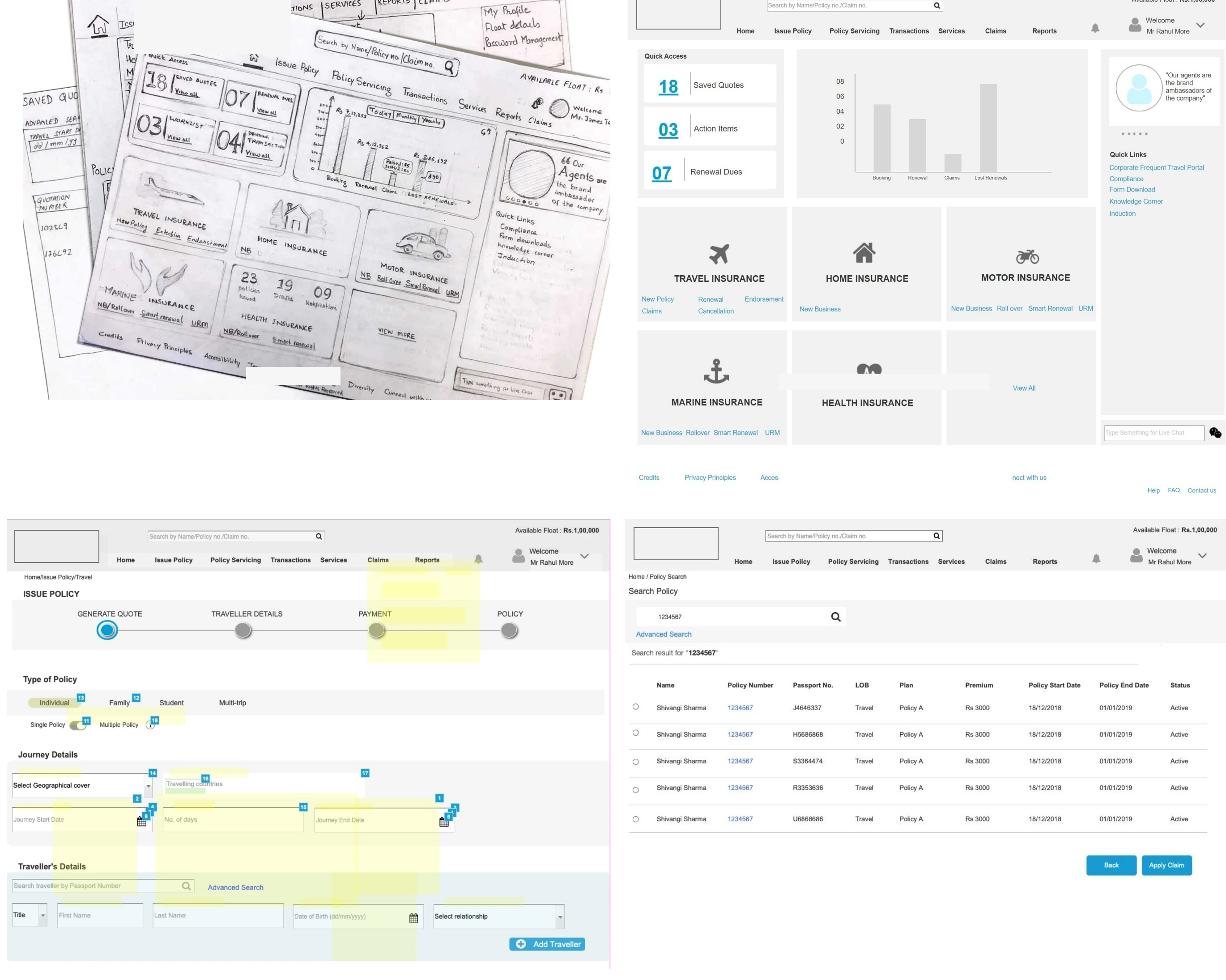
Revamped page sitemap
Hierarchical IA created based on finalized task flows and paper prototypes.

Scroll horizontally to read the full image.
Interactive prototype
The final set of unique screens were given to visual designers who worked on creating high fidelity screens. The screens were shared with developers using Zeplin along with complete library of various components that includes logos, icons, different states of interactive elements.
Desktop resolution
Mobile resolution
05 · Impact
Impact and outcome
Automatedmanual process of proposal form by replacing it with transcripts.
Simplifiedflow with consistent design language.
54 → 37mandatory fields.
1 minutepolicy issuance time, reflecting a 200% transaction-time improvement.
350%increased agent's online presence.
New businessthrough delivery excellence.